






by Subha Sankaran
Our prep week begins a good seven days before the children arrive, and one would think that would be ample time for teachers to set up, especially knowing that some schools give teachers only two days. And yet, throughout August, I saw teachers coming in here and there, puttering around their classrooms.
One teacher’s classroom looked completely set up and absolutely beautiful, but she was still unsatisfied.
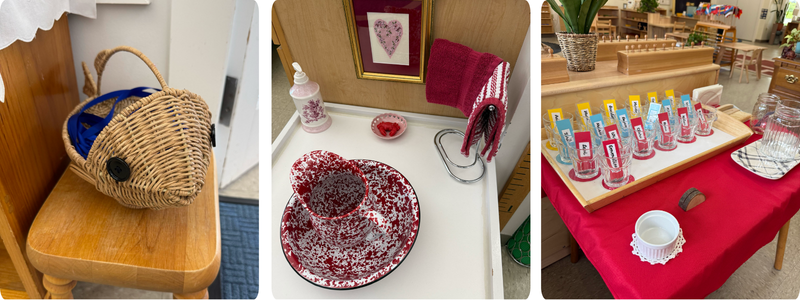
She had a fish-shaped basket she wanted to place by the entrance to hold the children’s name tags. The tags themselves were handwritten in beautiful cursive on acorn-shaped cards, carefully cut and mounted on cardstock, laminated, and finished with satin ribbon, so that our newest children would be known and welcomed from the moment they arrived.
But the basket wasn’t quite right.
She needed two black buttons of a certain size for the fish’s eyes.
She had looked in store after store, often after dinner, with her husband, who by then had become equally invested in the project. For five days, whenever I checked in with her, I heard about the fish and the elusive buttons. Finally, she found exactly what she was looking for and excitedly sewed them on.
Why All This Effort?
The meticulousness with which Montessori teachers prepare their environments can seem excessive at times. The perfect little soap for handwashing. The pretty box for the beads. The small bowl in which a bell is kept. The basket that apparently cannot be complete without exactly the right pair of eyes.
But these choices are not simply about making a classroom pretty. Beauty is part of the function of a Montessori environment.
Purposeful and Inviting
 There is very little in the classroom that does not serve a purpose, and often many purposes at once.
The plants are there for beauty, certainly, but also to give children meaningful work. A young child can water them, wash their leaves, notice their shapes, or compare their many shades of green to the gradations in the color tablets. An elementary child might observe how a leaf turns toward the light, learn to propagate a plant, study its adaptations, or discover the story of its origins and uses. So a variety of plants are carefully selected.
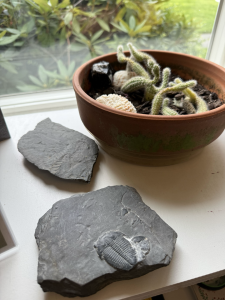
The soap on a handwashing table is chosen to fit comfortably in a toddler’s hand. The little brass figurines placed around a primary classroom are decorative, but they are also cared for by the children through brass polishing. A fossil in an elementary classroom will unravel the child’s imagination when they hear the story of the trilobite’s mass extinction.
These objects are purposeful, but they are also attractive. They invite attention. A child wants to handle them, smell them, feel them, examine them.
Beauty, in this sense, is not decoration added after an environment has been made functional. Beauty is part of what makes the environment function. It invites the child in.
The adult then connects the child to this environment, the child’s environment, and together they delight in its beauty. The teacher shows the child how to handle an object with precision, return it to its place, and care for it, almost as if it were a family heirloom.
A Place for Everything
Order matters for the same reason. Things have a place. Materials are complete and accessible. The child knows where to find what is needed and where to return it. This external order creates predictability and calm. A design that allows independence and choice, and, over time, supports the child’s developing internal order. The environment quietly says: You can find your way here.
And it says something else as well: This is your home. You belong here.
This Is Your Home
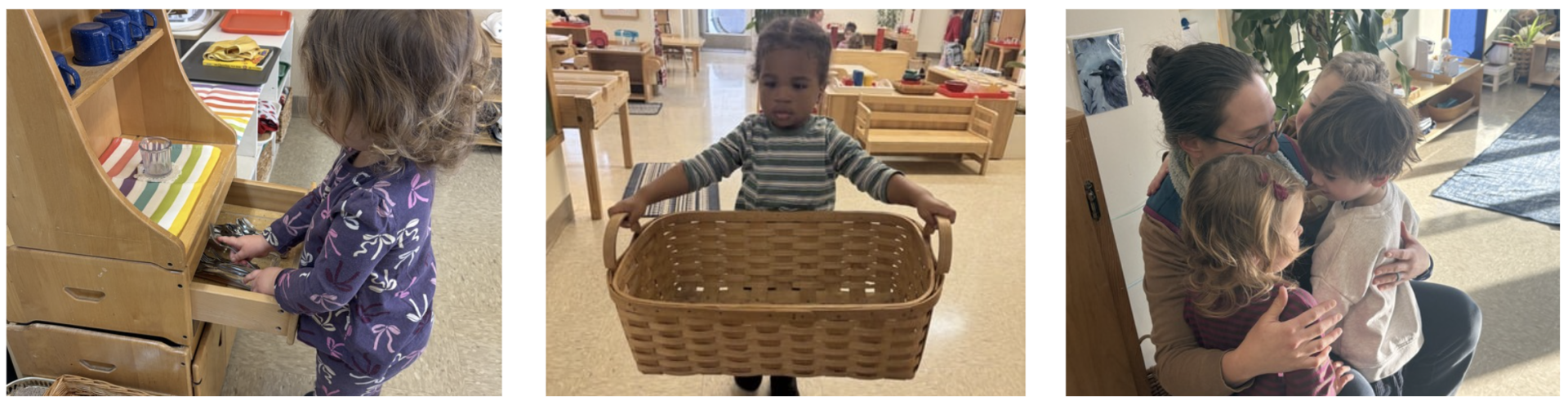
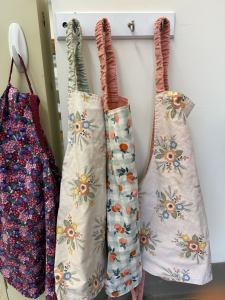 Montessori classrooms are deliberately home-like. There are plants and art, rugs and baskets, a kitchen, real dishes, placemats, napkins, and objects chosen with care. The environment is not simply a room adults have prepared for children to occupy. It is a place that belongs to the children.
Sometimes you can actually watch that transformation happen.
When a teacher acquires a new material for the classroom, whether purchased or gifted, it may be unboxed almost ceremoniously, with the children gathered around as though opening a present. They notice it. They appreciate it. They share their gratitude for it.
Even in Upper Elementary, I once opened and set up a new whiteboard while the children watched. That day, I happened to be beginning a poetry lesson, and I wrote the word “Ode” across the top.
Not knowing what it meant yet, the children immediately decided that Ode was the whiteboard’s name.
From that day forward, no matter what lesson I was giving, they insisted that I write “Ode” at the top first. It became an inside joke that connected them. By personifying this otherwise ordinary object, they had somehow made it ours.
This connection between child and environment, whether to a whiteboard, a beautiful object on a shelf, a classroom plant, or a garden, has enduring effects.
Learning to Look Closely
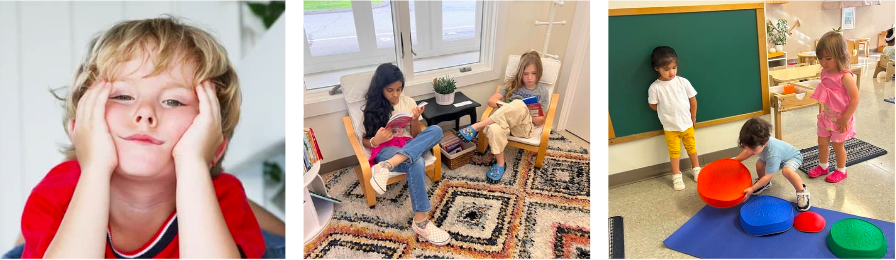
Children are naturally drawn to small things and interesting details. A rich environment gives them details worth noticing. They begin to look carefully. They discover that there is something to observe, some purpose to understand, some story behind almost everything.
And that habit of attention matters.
It is the beginning of the eye of a naturalist, an engineer, an artist, a biologist: Look closely. Notice what others might pass by. Wonder why.
Caretakers, Not Consumers
 This relationship with the environment also teaches something important about responsibility.
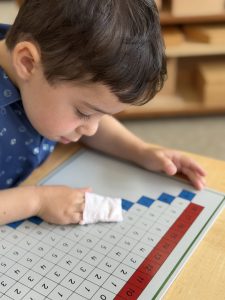
Twenty-five children may use the same material throughout a year. It may not be made of indestructible rubber or plastic. It may be wood, glass, ceramic, or metal. It could chip. It could break.
And yet, it can remain complete and beautiful.
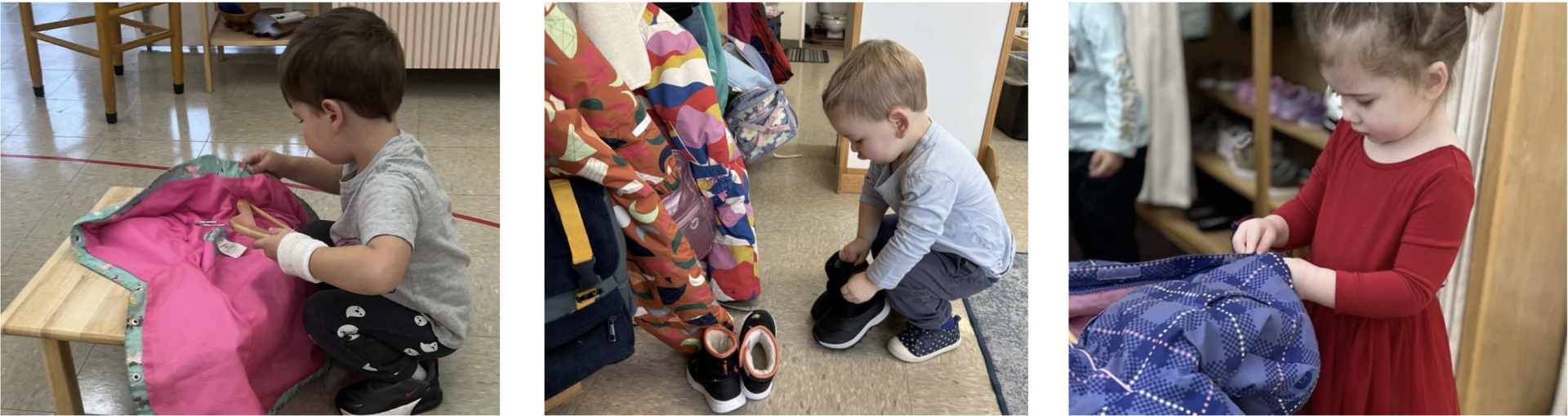
Children learn to carry things carefully. They return materials for the next person. Teachers repair and restore rather than automatically replace, involving children in that process when possible. Some Montessori classrooms contain materials that have been used and cared for by children for decades.
There is a lesson in that, too.
When something is beautiful and useful, when we know where it came from and understand that others will need it after us, we begin to develop a different relationship with things. We don’t simply consume and discard them. We become their caretakers.
The care of a classroom material becomes care of the classroom. Care of the classroom extends to the garden and the school. And, one hopes, that sense of responsibility eventually extends outward to the larger world we share.
But perhaps the most immediate purpose of all this preparation is much simpler.
It draws the child to the work.
The prepared environment is an invitation: to notice, to wonder, to choose, to work, to care, and ultimately, to take ownership of one’s own learning.
Which brings me back to the fish.
The children may never fully know what went into finding those two perfect black buttons. They will simply encounter a whimsical little fish waiting by the door, holding their carefully made names.
They will notice it. They will touch it. They will learn where it belongs and care for it.
Two little black buttons can seem like an awfully small thing.
In a Montessori classroom, small things rarely are.